6.48 mm diameter nozzle delivering 0.91 l/s to the runner which is rotating at 1084 rpm and generating 225 watts into the grid at an overall efficiency of 47%.
Showing posts with label Battery storage. Show all posts

Monday, 22 April 2024

Powerspout+Solar+Battery= the perfect combination.


I've posted a video on Youtube for those who want to know the 'length and breadth' of my home's energy system.

You can find it at https://www.youtube.com/watch?v=-rmYOUQAVTk 

You'll need 20 minutes to view it all, and it comes in HD.

I'll add a link to the side bar of this blog for future access.

------------------------------------

Addendum: added 23 April 2024

In response to people wanting to know the cost of the battery storage scheme, below is a breakdown. The numbers are in pounds sterling (GBP).

The costs given include VAT at 20% (the installation was done before the UK Government decided to exempt retrofitted battery storage schemes from the 20% rate).


Sunday, 4 February 2024

Benefitting from Battery storage

There can be no better way of communicating the benefit of having battery storage than publishing the graph below.

It records the energy my house has taken from the grid each month, starting at January 2023 and ending January 2024*; the battery storage was commissioned on 1st November 2023.

The step-down in grid consumption from November is quite remarkable, - more than I ever expected.

The data for the graph is reliable; the figures come from the meter readings sent to OVO, the electricity utility who sell grid energy to me.

I look forward now to seeing how this graph pans out over a full year; the three months in which battery storage has so far been contributing, have been months when the Powerspout has generated at its maximum and there has been little input from solar; later in the year, the mix will change, - and therein lies my interest to see how the full year looks.

* I will update the graph occasionally, to give the latest information.


Addendum added 15 April 2024

How the above graph 'pans out over a full year' will depend on how total energy generation from solar and hydro changes in the course of a year.
The pattern of how it changes is seen in the graph below.
The graph shows the total kWh generated each day from hydro and solar, between October of one year and September of the next.
The blue spiky line is the kWh generated each day.
The value of the data point for each day is the 8 year average of the energy generated on that day.
The red polynomial line is the 'best fit line' for the blue line.
It will be seen that maximum generation is from mid February to June, and in this period the graph above can be expected to show the least energy taken from the grid.
Conversely, least generation happens in September / October, and in those months grid supplied energy is likely to be needed.


Wednesday, 24 January 2024

Priorities ! - part 1

Having added battery storage to my home energy system, a dilemma has been created; and that dilemma is how to prioritise the different uses for where home generated electricity can go.

To be clear what these uses are, and to place them in a descending order of rank, they are:

  1. the moment by moment electricity needs of our house 
  2. domestic hot water heating (DHW), - or more precisely, topping up the temperature thereof from the temperature reached by a log burning stove whose back-boiler also supplies central heating warmth to radiators, and never gets to be > 40° C
  3. charging the battery of our BYD home energy storage system (10.2 kWh of storage, max. input / output capacity of battery inverter is 3.7 kW)
  4. charging the battery of our old model, Nissan Leaf EV (which has the smaller 3.3 kW on-board charger)

Apart from the dilemma of ordering the prioritisation of these loads, there is the matter of devising a way of ensuring that home generated electricity goes where I want it to; and in order for it to be possible to make it go where I want it to, for that I have to have some means of 'seeing' where power is going at any given moment.

Another fundamental matter to be clear about is the philosophy I follow for how I want my home micro-grid to operate; although I am grateful for any savings I make on needing to buy-in grid energy, I am not in the business of 'doing home generation' for the sake of making money; my hydro and solar installations are both accredited for Feed in Tariff payments, and there is thus a nice revenue stream coming from those; beyond that source of income, fancy schemes such as are offered by Octopus Energy, - a company offering attractive reduced tariffs for bought-in energy at certain times of the day, and generous Smart Export Guarantee (SEG) tariffs for exported energy, - these I view as 'baits' simply to get me to sign up, and for me they hold no appeal whatsoever.

Rather, the philosophy that guides me is one of simple self-sufficiency, - the contented feeling of being able to cook, light the house, bath in hot water, and travel the limited distances we need for shopping, - and know that all the energy for these things has come from one's own 'power station', using 100% renewable energy.

At the time of writing, in January 2024, my home battery storage has been up and running for just 3 months, and those three months have been exceptionally wet; as a result the Powerspout has been producing at maximum output (900W) almost continuously and its 24 hour total output of 21.6 kWh has been more than enough energy to supply all our needs; in fact much of the time there has been so much energy that there has been some to spare which, rather than let it go out to the grid, I divert to one or both of two subsidiary loads; one of these is a DHW load and the other a space heater load, and both are in a part of the house which is presently not occupied; though unoccupied, sending power there helps to keep away the winter chill in that part of the house.

Visualising and controlling how electricity is being used around my home is crucial. 

The 'visualising' is made easy with an iPad because each bit of kit in the system can be called up in the local area network (LAN) or via SMA's Sunny Portal interface; thus the battery state of charge (SOC), the power flow at the grid connection point, the total of home generation from combined hydro and solar, whether the inverter is charging or discharging the battery, and which load the DHW diverter is feeding to, - all these are accessible from the comfort of an armchair.

Controlling is achieved with no less a degree of ease; it involves a certain amount of 'automaticity' and a certain amount of 'manual tinkering'.

Careful scrutiny of the single line diagram below indicates that the design of my system ensures that diversion to heating DHW is the first priority for where surplus home generation goes; the diversion device controlling this is a Solarcache, and by way of it, two priorities of load are controlled; when the first priority load, which is the main house DHW supply, is up to temperature and its thermostat is OFF, the second priority load is switched ON; as a result of the way I have set it up, the second priority load is comprised of the two loads previously mentioned, one being the subsidiary DHW load and the other the space heater load, both located in the chilly part of the house.


Each of these 3 Solarcache loads (one on first priority and two on second priority) is wired from the main consumer unit via its own dedicated RCBO (residual current breaker with overload), and whether a load is capable of receiving power is easily controlled by manual operation of the RCBO switch; thus 'automaticity' is achieved by the way Solarcache switches between its two priority options, and 'manual tinkering' by the RCBO switches, which determine which, if any, of Solarcache's connected loads is actually available to receive power. 

Happily the RCBO switches are very close to the armchair previously mentioned, and that makes 'visualising' and 'control' not only a convenient task, but a fun one too.

So much for the basic layout of how electricity is used around my home for meeting the first two priorities on my list, - the moment by moment power needs of the house and using any surplus primarily to heat DHW.

In Part 2, I'll explain how the BYD storage battery is kept charged, how the Nissan Leaf is charged from stored energy in the BYD battery, and why the technology of a MyEnergi Zappi doesn't seem to have a place in my set up.

Monday, 11 December 2023

Battery storage completed.

In previous blog posts on battery storage, I waded through the deliberations that burdened me as I struggled to reach a decision about proceeding with it; in this post, I just want to show what actually came of it all.

In a future post, I’ll look at the system's pros and cons, but I'll write that when more time has passed with it being operational. At present, it has only been operational for 6 weeks. In that time our energy consumption from the national grid has been less than 5 kWh (before it was 200 kWh for the same 6 week period in previous years), - so early impressions are favourable.

Location for 'battery bunker' BEFORE construction

Battery bunker AFTER completion

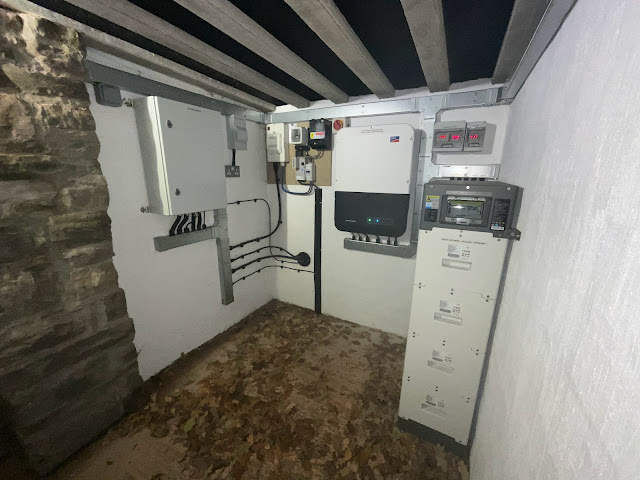
Inside the bunker

Meters for ac frequency and volts, and battery dc volts; the switch is the 'black start switch' for manual operation of battery back-up

BYD HVS battery tower, 4 battery modules totalling 10.24 kWh, with Battery management Unit on top

SMA Sunny Boy Storage 3.7-10 inverter with ac ON/OFF switch

Connection compartment at bottom of SMA inverter; additional devices on the right are a DIN rail mounted, 5 way, Ethernet switch and its 12vdc power supply

Cable entries to underneath of Enwitec Battery Back up box; the Enwitec box accomplishes all the switching arrangements for transfer from grid supply to battery supply when there is a grid outage, and back again to grid when the grid is restored; this it does either automatically or manually; manual control is by means of the "black start switch".

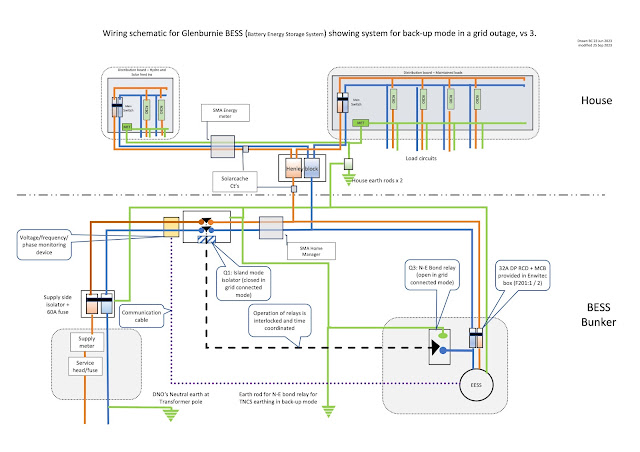
The inside of the Enwitec box; The key component monitoring power flow at the grid connection point is the SMA Home Manager 2; it is the device to which the green Cat 6 (shielded) ethernet cable is plugged into. The contactor Q1 on the left side is the device which isolates the property from the grid when battery backup is in operation. Relay Q3 is the device which ensures grounding of the neutral conductor when in battery backup mode. F1 and F2 are mccb's protecting the power supply to the Enwitec box, one for grid supply and one for battery backup supply; F201:1 and F201:2 are respectively an mcb and a rcd on the ac line connecting to the SMA SBS inverter.

The incoming National grid supply, and its meter, were moved into the bunker from their previous place in an outside receptacle on the wall of the house; this was to make more simple the cabling arrangements for battery back up; the earthing arrangement when on grid supply is TT, and on battery back-up operation it changes to TNCS. 

In the house, two new consumer units were installed, one for house loads and one for in-coming power from the two renewables available:- these are the Powerspout and 3.2 kWp of solar; the total generation from these two renewable sources is measured by an SMA Energy meter; this is the device with a red ethernet cable connected to it; the data from the Energy meter is made available by Ethernet cable connection, via a LAN network, to the SMA Home manager (in the Enwitec box housed in the bunker); also, the data from all devices in the system is made available, via a www connected router, to SMA's web interface; this they call Sunny Portal; next year 2024, for systems which have a Home Manager, SMA will be replacing the classic version of Sunny Portal, with their new web interface called Sunny Portal powered by ennexOS; when that comes, the User interface will have, so they say, a new fresher look.

The user interface provides all the expected features of instantaneous and historical energy flows that one expects from such technology; the parameters and configuration of the SMA SBS inverter can also be accessed directly via the LAN network, and this is essential in setting up the system and for investigating faults when they arise; following SMA's advice, which they strongly encourage, I went for cabled communication throughout, rather than using WiFi.

This is our meter measuring in-coming energy from the national grid; the pencilled readings top and bottom were the readings on the day when the battery storage first started operation, and that was 41 days ago; you can see that in those 41 days only 0.6 kWh of low rate energy has been used, and 3.1 kWh of normal rate; in that time we have cooked, heated our domestic hot water, charged our Nissan Leaf umpteen times, and met all the 'base load' requirements of a normal modern house; as I mentioned at the start, normally this would have taken around 200 kWh, - so the battery has, thus far, been 'transformative' !

For the really technically minded enthusiast, here are the schematics for the scheme as it was finally constructed:


Friday, 11 March 2022

Battery back-up for grid outage

 The electricity grid where I live is well maintained; grid outages are rare and when they do happen they are usually brief.  But like everybody we have a freezer and a central heating pump so the consequences of a power failure are not without reckoning: the possibility of food lost or the inability to keep warm in the middle of winter.

A more subtle pressure to consider a particular type of back-up comes from having a Powerspout contributing to house electricity 24 hours a day; though the turbine will remain operational during an outage, it cannot deliver its output to the house unless its inverter is working, and when the grid goes down, the rules are that a grid connected inverter must stop working; how frustrating is that ! - to have hydro power available and yet not be able to make use of it !

So the subtle pressure is to opt for a particular type of back-up which would allow the Powerspout to continue supplying the house.

The differing factors to be considered make the decision a delicate matter; it's delicate because the added expense and complexity are considerable for a system that would see the Powerspout continue to supply the house.

As often happens, the factors which sway a decision are in the detail; not all grid outage back-up systems are the same and household electricity safety requirements rule out some configurations which might otherwise be possibilities. 

So what are the details of the different options, and what operational technicalities have to be thought about?

Back-up by way of a secure outlet.

This is the simplest option because it doesn't require the house distribution system to be islanded (ie: isolated) from the utility grid, - but in not requiring islanding the option doesn't allow the Powerspout to supply the house in an outage; it is also simple in that it is not automated and would require manual switching, both for switching on and off.

The way it works is that power is supplied from the battery, via the inverter, to a single socket which is not a socket like any others in the house distribution system. It stands alone outside from any house ring main and has no connection to the house fuse board (consumer unit). 

Into this socket, either directly or via an extension cable, can be plugged those loads which are deemed essential. The maximum power that can be drawn is limited; for SMA inverters it is 3.68 kW. How long power will be supplied depends on the size and state of charge of the battery, as well as the size of the load connected.

The position where the secure outlet is located is clearly of importance in order that loads deemed to need power can be connected to it.

Manufacturers of battery charger / inverters offering a secure outlet include SMA in their SunnyBoy Storage 3.7/5.0/6.0 range.


Back-up by way of islanding.

This is the option which is the attractive one because it allows the Powerspout to continue to contribute during an outage.

To island a house means to completely separate it from the utility grid; in a typical house supplied by single phase power, this entails interrupting both the live and neutral conductors where they first come into the house; the isolation has to take place between the utility company's meter and the house consumer unit. 

For safety reasons, because the neutral conductor is always made to be at zero potential (or at least near zero) by being earthed outside of the house by an earth connection constructed by the electricity company, interruption of the neutral as it enters the house will mean the neutral conductor loses its earth connection and will need to be re-connected to earth on the house side of the dis-connect; this has to happen at the same moment it is dis-connected from its outside earthing and at the same moment the live conductor is disconnected.

The new earthing of the neutral can be to the earth rod the house will already have, or it can be to a new and separate earth rod. Details about this can be found in this very informative on-line document.

The switching necessary to accomplish everything is achieved easily enough, and automatically, using relay contacts housed in a secure box, and it is best if this is sited near the point where the utility supply first comes to the house. 

Many manufacturers offer this type of hardware, for example Tesla, Sonnen and SMA. 

Whether power from the battery supports the whole house or only some circuits within the house is a question which can only be answered by estimating the load for each of these two options and weighing that against the ability of the battery and inverter to meet it; 

Battery inverters are not all equal in how much power they can output, and not all batteries are equal in the maximum power they can deliver, so careful consideration needs to be given to ensure that battery and inverter have matching power output ratings sufficient to meet the load of either the whole house, if that is chosen, or just selected circuits such as lights / freezer / central heating pump.


A point of detail: "What would happen if..."

Attention to the detail of how my system would operate if I choose the option of 'islanding' and continuing to have the Powerspout contribute to the islanded grid is the question "what would happen if too much power is being generated into the islanded grid"; it is a question to which as yet I'm not sure of an answer !

The situation could arise (a worst case scenario which might never actually arise but which needs to be catered for) where there is a grid outage, the house is islanded and being powered by the battery, nobody is at home so house consumption is very low, say < 300 W, the state of charge of the battery is 100% and so can receive no further energy input, and yet both solar and hydro 'generators' are feeding into the islanded grid their outputs, of perhaps over 2 kW; a surplus of 1700 W exists in the system.

Where does the surplus power go ? what happens to ac voltage and frequency in a situation like this ? what can be done to manage the situation ?

These are all questions which still need answers and solutions; until I find them, for me back-up by secure outlet rather than islanding may prove to be the safest, maybe even the only way to go.

Any suggestions are welcome !

Thursday, 17 February 2022

Figuring battery size

There are a host of considerations to take account of when deciding how many kWh of energy storage are needed for a domestic battery storage system; if I choose too big a battery, the surplus available from self-generation may not be enough to fully charge it, and additionally it will be needlessly expensive; choose too small and it may not have enough storage to meet the functionality I want.

So an early decision in the journey to installing battery storage is to be sure what I want. 

There is a divide based on complexity between two options, with a further divide in the second option; the  technically simplest option is to store energy so it can be used at times of peak demand, thereby reducing drawing from the grid at those times; the more complex alternative is to have that capability plus the capability to back up the house in the event of a grid outage.

The further divide in this latter alternative is whether it is 'whole house back-up' or 'secure outlet back-up'; the distinction between these is important because 'whole house back-up' will allow the Powerspout to continue to feed its output into the house grid when the house is disconnected from the utility grid, whereas a 'secure outlet back-up' only provides a single, switched, power outlet to which emergency loads can be plugged in. In a grid outage, being able to make use of the Powerspout's output is obviously very desirable, so if at all possible, that is what I would like to go for. 

Grid outage back-up of either type requires the battery to be able to store more kWh, and questions immediately flag up - how much energy does my house use, when are the peak times of usage, and how great is the power drawn at times of peak demand. 

With these 'demand-side' unknowns in one pan of the scales and 'supply-side' unknowns in the other, - supply-side questions being: how much surplus energy does my installation produce, and how does this surplus differ between summer and winter months, - a delicate weighing up operation needs to be undertaken to balance the one with the other.

The whole matter becomes rather complicated, and working through to a properly reasoned conclusion can only be done by having data, - the more data the better, and data covering both 'demand-side' and 'supply-side'.

Below are graphs to show my 'supply side' data; they document my hydro and solar generation over the past 6 years: 


The bars in the main graph show energy generated each day of an 'average' year; such a year is a hypothetical one concocted from the averaged data from the 6 years from 2016 to 2021; the individual years are shown in the smaller graphs above and below the main plot, to make the point that real years are never quite the same as an 'average' year.

The graph shows that 'typically' the lowest level of self generation happens in September / October and is around 10 kWh / day. Highest generation peaks at 30 to 35 kWh / day in March / May when solar output is picking up and yet hydro output is still good due to groundwater having been replenished by rain which fell in the previous December to March period.

So much for my 'supply-side' data, which being accumulated from 6 years of record keeping is about as reliable as one can hope for; what about 'demand side' data? 

Below left is a plot of energy consumption from the grid in a month; for our house, all months, winter or summer, look the same; 
note it is not a complete picture of house consumption because it does not include energy consumed which is self generated; to get that full picture, the number of kWh consumed which are self-generated need to be added, and that number comes to, I have established, an additional 10 kWh / day; the graph below right shows this daily addition (in blue), so the graph now represents the complete demand-side picture over one month:


It will be clear from the above graphs that on days (in truth, nights, - so use is made of cheap rate, night-time energy) when my Nissan Leaf is charged, the grid energy taken is in a different league to other days, 20 kWh compared to 3 - 6 kWh; this is important to keep in mind when deciding on battery size; if I rule out any hope of storing sufficient kWh to charge the car from energy stored in the domestic battery, then the battery only needs to be big enough to cover each day's domestic consumption taken from the grid; a battery of 5 - 6 kWh capacity would be plenty large enough for that, whilst to charge the car from stored energy would require a 20 kWh battery.

I have established that the demand each month is much the same in one month to the next, regardless of the time of year, so the pattern of monthly demand can be scaled up to a year pattern simply by repeating it 12 times; it then becomes possible to see how data for 'supply side' and 'demand side' relate to each other if the one is overlaid on the other; as the following graph shows, where blue bars are not overlain by red bars, that represents surplus generation which is available for storing in a battery:


Interpreting the graph further, one can conclude that for the 9 months between December and August, the excess of generation over consumption which is indicated by blue bars not being covered by red bars, amounts to at least 5 kWh/day, and this should make it possible to have enough surplus energy to fully drain and re-charge a 5 kWh battery each day throughout that period; within that 9 month period, there are 7 months from January to July when the margin of surplus is much more generous, at 10 to 15 kWh /day.

Here however, a caveat needs to be remembered: these calculations are founded on 'averaged' data taken over a 6 year period; if the actual data of each of those 6 years, given above, is scrutinised, it will be clear that in any given year, the 'supply side' data is quite variable; the import of this is that in some years things will not work out as anticipated.

...but a battery of 5 kWh seems to be the size for me and it is the size I am contemplating getting; it will be big enough to cover what we usually take from the utility grid each day and it should be enough to cover 'grid outage back-up', whether I go for the option of 'whole house back-up' or 'secure outlet back up'.

Next time, we'll look into those two options.

Monday, 14 February 2022

Towards battery storage

For quite a long time, I have been thinking about adding battery storage to my set up; the recent eye-watering rise in the cost of grid-purchased electricity here in the UK is finally driving me from thinking about it to acting on it.

It is not a simple matter however; choices about battery size, whether to include grid outage back-up capability, where to physically locate the battery and charger/inverter, - all these and much more have to be worked through, and inevitably compromises identified and accepted.

I have persuaded myself that the case for battery storage is unassailable. My reasoning goes like this: my Powerspout is good at delivering energy over long periods at low power levels; batteries are good at delivering energy over short periods at high power levels; by combining the two, advantage can be taken of their respective strengths.

In effect, for a grid connected Powerspout like mine, a battery can be used to address the limited capability of the Powerspout to deliver sufficient power when domestic appliances like a kettle or cooker are turned on; the battery opens the door to saving on the energy which would, without a battery, be drawn from the grid.

In the complicated journey of working out how to configure a battery system, a major 'road block' has been how to integrate the existing diversion device I have, a Solarcache; it harvests surplus energy and diverts it to 3 different heating loads in the house, always maintaining a bare minimum of power to trickle back to the grid; it has been a very valuable component of our system which we have come to rely on as our sole source of domestic hot water in the summer months; I am keen not to have to jettison it with the introduction of battery storage.

The 'road block' was because my Solarcache was an early model which lacked the later firmware which enabled Solarcache to be adjusted so the battery management system (BMS) got first priority of surplus power; 

Happily, yesterday that block was removed; I discovered I had a spare Solarcache with the required firmware update; below is the screen from it which shows how the Solarcache's settings can be adjusted to give the BMS priority.


The settings allow for a threshold level of Watts flowing back to the grid, and a delay time during which that power needs to flow, before Solarcache will start to divert power to the loads connected to it. Discrimination between the settings of the BMS and Solarcache can thus be achieved to ensure the BMS gets first priority.

I was really excited at discovering I could keep Solarcache alongside the battery system; having removed that particular 'block', I now feel free to progress the battery scheme further.

I'll post more in due course.